Over the past year I have served on the Fishers Innovation Grant Committee. Mayor Fadness asked me to form the committee and help in its implementation. The city wanted to promote innovation in our school district. The city provided $500,000 in the initial grant and provided another $50,000 in the 2025 budget. The city has distributed $350,000 to the HSE school district at every level across the district. The city has funded everything from music program development, STEM programs, ENL programs, virtual reality equipment, multi-media programs, and skilled trades.
The committee’s work has confirmed what I already knew; the HSE school district is filled with teachers doing amazing work. We have awarded a number of STEM education grants; of those we supported Robyn Stout (SCIS), Lisa Harvey (FES), Jennifer Suskovich (MakerSpace), and John Hochstetler (RVIS) stand out. The committee had a chance to watch Lisa’s class use the LEGO Spike program with her 3rd grade students. I love watching great teachers teach…. I love the craft. Technology without craft is just play; what stood out was watching the kids fail, problem solve and try again repeatedly without quitting. Help came in the form of encouragement and revisiting the problem-solving tools they had learned. Robyn’s program at SCIS focused on 6th grade students to provide a bridge from Jennifer’s 5th grade STEM program and the junior high’s programs. Robyn’s passion for STEM is contagious. Her room radiates challenges and energy. Our district is blessed to have two true agents of change in Jennifer and John. Their programs are benchmark programs that should serve as models in and outside of our district.
One of the show-piece programs in HSE schools is the media programs at Hamilton Southeastern High School; the programs are innovative and forward-looking. David Young, Bill DeLisle, and, tangentially, Jamie Follis, a social studies and film teacher, have carved out award-winning and transformative programs. Their student-centered productions are so relevant and reflective of today’s media needs. The city updated their equipment and provided new equipment needed to create a series of short films to augment their award-winning feature film productions. What stands out the most in their programs is that the students engage in every aspect of production and most importantly they produce amazing work. These programs cover announcements, weekly programs, short films, long films, and social media work. These soft and hard skills transfer easily into the marketplace and into higher education programs. My only wish is that they and the district would brag more about what they are doing; although, they were just featured in a district newsletter. The community would be impressed if they could see snapshots of what these kids produce.
Our district benefits from a group of unicorn teachers teaching English as a New Language. Our committee funded Virtual Reality and translation tools for this group of amazing teachers. Becky Schroeder, Jim Ziino, Jeff Brunnemer, Jenifer Young are using innovation and passion to increase the English proficiency and more importantly integration into school for a huge number of students. At our final grant award cycle, we happened to be at Hamilton Southeastern High School as the ENL teachers received their students’ proficiency growth data for the year. The data was startling in how much the kids had grown over the year. This is a testament to the work of the students, but just as important the dedication of a group of teachers that used innovation to move the needle on their kids. There was a blurb in the district newsletter, but it does not really capture the achievement. The consistent theme of these teachers is dedication to seeing their students succeed.
Things that I Would Love to See in the District
A commitment to STEM. STEM has been an educational buzzword for most of my former teaching career. Professional development hours have been dedicated, speakers provided, readings distributed, and our district has STEM pillars in some schools and little in others. The city does not have the resources to plant a STEM program in every school in the HSE district. One of the members of the grant committee is an expert on STEM programs; especially as it relates to STEM state certification requirements. Kaleigh would have a great STEM coordinator and elementary STEM out-reach coordinator. She would be great as a mobile STEM teacher, bringing programs to every elementary school and grades lacking a program.
The District Needs an AI Vision. Every school district in the country needs to get in front of the impact of AI on education. AI is a great tool for people with an advanced executive function; defined as the ability to recognize poor results, critically view returned information for relevance, and pose questions with enough conditions to get the results desired. The challenge is that students do not have these functions developed enough to be critical consumers of AI results.
Every district must focus on executive functions.
- Critical Thinking and Fact Checking. Students must be able to analyze the AI responses for accuracy, bias, and completeness. They need to practice fact-checking using multiple sources. Build habits of asking good questions—clear, focused, and purposeful—this is harder for students then you think. Watching students trying to search Google is painful for most teachers.
- Cultural Literacy. There is a place for cultural literacy in today’s world. Even though you can look up anything, you must know what is possible to be able to search. Anyone who took my class may remember cultural literacy tests (people, places, events, key concepts). My goal was to create a core of knowledge from my year. Anything learned in September should still be known in May or why else would you teach it? This is critical to the growth of the executive decision-making process of recognizing when AI is wrong.
- Teach what AI is and is not. AI is not truth…it predicts text from known text. AI’s limitations must be taught (bias, misinformation, and why it loses it way). It is also important to teach about AI’s controversies; is it plagiarism, should AI cite its sources, etc.
- AI is regurgitation not originalism. Teachers need students to focus on what is important, reflection, perspective, empathy, point of view and synthesis.
- Teachers need to know how to teach in an AI dominate world.
One place where I would like to see the district be proactive is through remediation. I have done some research into Khanmigo and have discovered its strengths and weaknesses (the same as all AI platforms), but extensive study might be worthwhile. I know of one person at the HSE central office who just received his master’s degree in AI technologies and would be a smart choice to lead this kind of study; not to mention that he is curious and his knowledge recent.
In a world of AI at your fingertips, teachers need to relook at the idea of homework. If a student is old enough to have a smartphone, then the student has unrestricted access to AI tools. The strength of AI as a homework helper is that it manages the bottom four layers of Bloom’s Taxonomy with amazing accuracy. Some may quibble of the “analyze” layer but go to ChatGPT and try some of your standard homework questions and ask yourself if you would accept the answer.
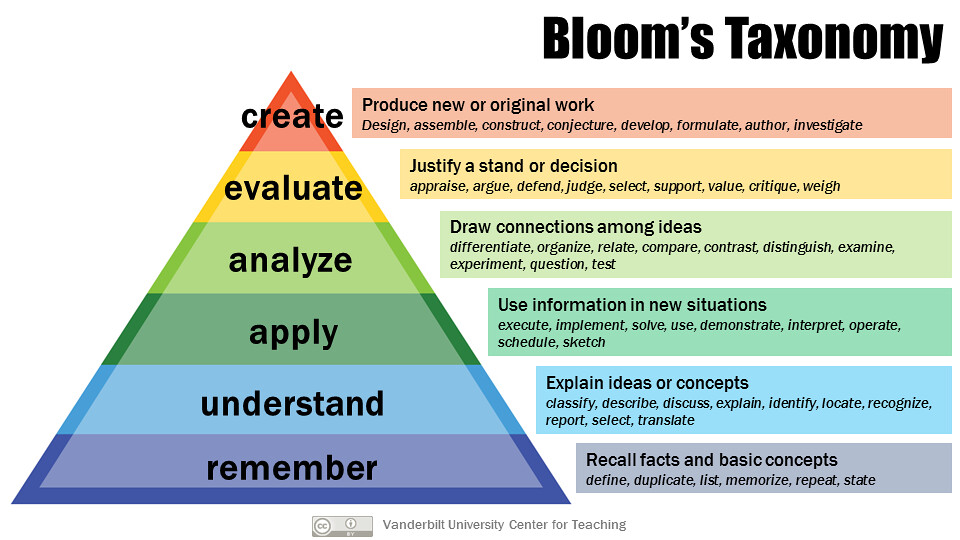
I stopped giving homework in my last years of teaching. My reasons were simple. I wanted to control the learning process and to be there when the struggle occurred. It made my practice and formative assessments more focused. This was a focus during my Social Studies methods classes at Ball State University this spring. The kids were shocked how quickly and accurately AI did math homework and answered questions on worksheets.
I would like to thank the people that I work with on the committee; Kaleigh Arndt, Amy Murch, Brad Jackson, and Jordin Alexander.
 Lambs to Lions
Aug 08, 2025 @ 17:23:11
100%. All of it.