In a recent video posted to X, Micah Beckwith decided to flex his historian muscle and political science analysis. After setting up the dynamics of the 3/5ths Compromise; he decided to add his political scientist analysis by saying that “It was not. It actually was the exact opposite — that helped to root out slavery,” He finished his crack analysis, “Don’t buy into the DEI, radical revisionist history.”
You can watch the video at https://x.com/LGMicahBeckwith/status/1915475812087898137
During the Constitutional Convention, Southern slave states were fearful that they would be overwhelmed in the House (representation based on population) by the “large” states—Massachusetts, Pennsylvania, New York and Virginia (state with the largest number of slaves). To increase their representation, the Southern states wanted their large number of slaves to be included in the population count. Of course, the large states (not counting Virginia) did not want to relinquish their numerical advantage in the House. Some delegates argued slaves should not be counted at all—after all, they said, slaves are property, not persons.
Fundamentally, Beckwith misses one major point at the core of the argument…the compromise was necessary because the United States enslaved people. Period. Even though many of our Founders held slaves they wrote extensively on its fundamental abhorrence. It is interesting to read Patrick Henry’s thoughts on slavery. Many of these founders who held conflicting views were addicted to the benefits of slavery. They were subject human failures just like everyone, they were not demi-gods.
If you want to see the duality in its time read Federalist No. 54, which addressed the Compromise’s core arguments. Below are two powerful (for me) excerpts:
Section 4. Change Law, Slaves Become Citizens
“We subscribe to the doctrine,” one of our Southern friends might observe, “that representation relates more closely to persons and taxation more closely to property. We join in applying this distinction to the case of our slaves. But we must deny the fact that slaves are considered as merely property and in no way whatever as persons. The true state of the case is, they have both qualities. Our laws consider them, in some respects, as persons and, in other respects, as property. “Since the slave is forced to labor, not for himself but for a master, since one master can sell him to another master, since he is subject at all times to be restrained in his liberty and chastised in his body by the capricious will of another—the slave may appear to be degraded from the human rank and classed with those irrational animals which fall under the legal denomination of property. “On the other hand, by being protected in his life and limbs against the violence of all others, even the master of his labor and his liberty, and in being punishable himself for all violence committed against others—the slave is clearly regarded by the law as a member of society, not as a part of the irrational creation. He is regarded as a moral person, not as a mere article of property. “The federal Constitution, therefore, is correct when it views the character of our slaves as a mixture of persons and property. This is, in fact, their true character. It is the character bestowed on them by the laws under which they live. And it will not be denied that these are the proper criterion. Non-slave states dispute the inclusion of slaves in the computation of numbers. But the pretext of laws, alone, has transformed Negroes into property. And it is admitted, if the laws restored the rights that have been taken away, the Negroes could no longer be refused an equal share of representation with the other inhabitants.
Section 5. Condemn Slavery, Yet Call Slaves Property.
“This question may be looked at in another way. Everyone agrees that just as wealth and taxation are measured by numbers, numbers are the only proper measure of representation. Would the convention have been impartial or consistent, if they had excluded slaves from the list of inhabitants when calculating representation, then inserted them to calculate tariff contributions (taxes)? Could it be reasonably expected that the Southern States would agree to a system that considered their slaves, in some degree, as men when burdens were imposed, but refused to consider them in the same way when advantages were conferred? “Wouldn’t there also be some surprise that the same people who reproach the Southern States for the barbarous policy of considering part of their human brethren as property, should now contend that the government, to which all States are to be parties, should consider this unfortunate race more completely in the unnatural light of property than the very laws they complain about?
The compromise was found in Article 1, Section 2 of the Constitution was a compromise, incorporating ideas of both property and person: Population would be calculated by adding “the whole Number of free persons, including those bound to Service for a Term of Years, and excluding Indians not taxed,” plus “three fifths of all other Persons.”
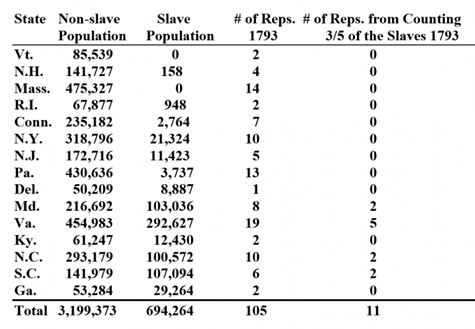
Source: Center for the Study of the American Constitution. The Impact of the Three-fifths Clause on Representation in US House of Representative, 1793.
Beckwith also asserts that the compromise hastened the end of slavery. WTF. The three-fifths compromise had a major impact on U.S. national elections and governance for decades. For example:
- 10 of the first 12 presidents were slave holders.
- The Southern Slave State advantage would also keep legislation based on population from being passed through the House of Representatives. So, the Southern Slave states received the advantage in representation, but none of the disadvantage in taxation.
- As a result, the vast majority of Supreme Court justices were appointed by slave-holding presidents; include Roger Taney, appointed by Jackson, who wrote the majority opinion in Dred Scott v Sandford des to come. Which ruled that slaves were property even if they moved into a state that banned slavery.
- Thomas Jefferson election to the presidency would not have happened 1800 without the 3/5ths Compromise advantage in the Electoral College.
- The 3/5ths Compromise advantage allowed the passage of the Missouri Compromise of 1820, which allowed Missouri to enter the Union as a pro-slavery state.
- The Compromise allowed for the passage of the Indian Removal Act of 1830, in which Indigenous peoples were forcibly removed from their land.
- The Compromise allowed for the passage of the Kansas-Nebraska Act of 1854, which allowed residents to determine for themselves whether they wanted to allow the enslavement of Black people in their territories.
The 3/5ths compromise may have allowed for the ratification of our Constitution, but there was a human cost. As a result, the entrenchment of slavery in our founding would have a direct link in the Civil War and the extreme cost in human lives.
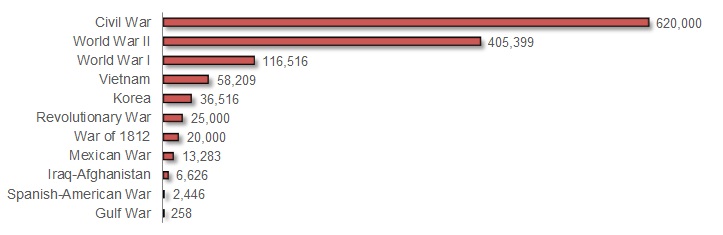
Sources: Fox’s Regimental Losses; United States Department of Veterans Affairs; Library of Congress: American War Casualty Lists and Statistics; Official Records of the Union and Confederate Armies; National Park Service

Available at: https://www.raygunsite.com/products/america-needs-historians
 Lambs to Lions
Leave a comment